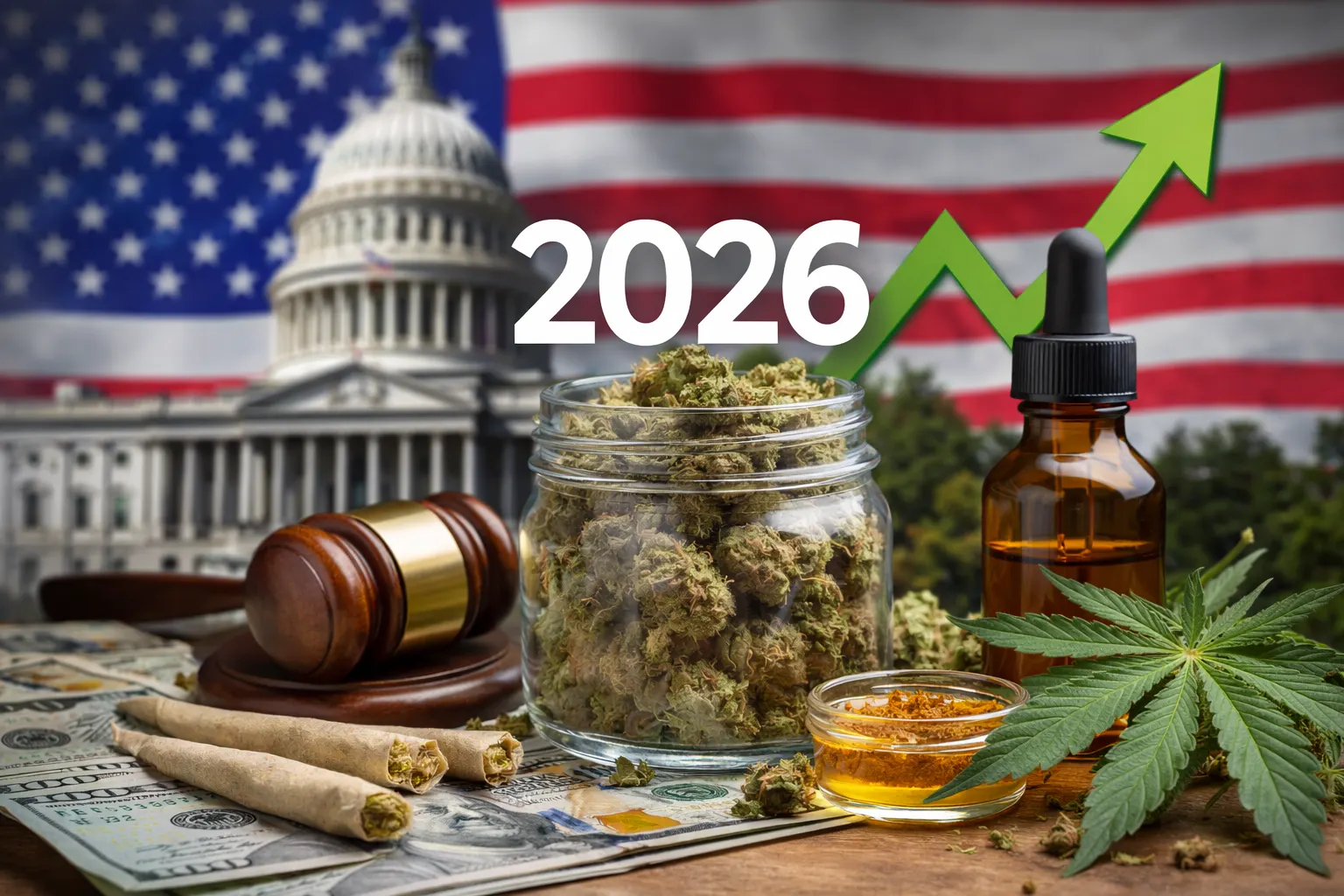
The cannabis industry is moving fast — and if you haven’t checked in recently, a lot has changed. From new state legalization votes and a presidential executive order to a market now approaching $47 billion, the latest cannabis industry updates paint a picture of an industry that’s growing, shifting, and still figuring out its legal footing all at the same time. Whether you’re a consumer, a business owner, or just curious about where things are headed, here’s everything you need to know about what’s happening in 2026.
⚡ Quick Takeaways
- The U.S. cannabis market is projected to reach nearly $47 billion in 2026, with adult-use now legal in 24 states.
- Cannabis legalization news in the USA in 2026 includes active ballot measures in nine states, a federal rescheduling push, and new social consumption laws.
- Product trends are shifting — edibles, pre-rolls, and minor cannabinoids are all gaining significant ground.
There’s a lot of noise around cannabis right now. Some states are moving toward legalization while others are pushing back. Federal policy is in flux. And the consumer market is evolving faster than many businesses can keep up with. So instead of vague predictions, let’s look at what’s actually happening right now — with real numbers and real context.
Where Does Cannabis Legalization Stand in the USA Right Now?
As of 2026, the legal landscape looks like this:
- 24 states + Washington D.C. have legalized adult-use (recreational) cannabis
- 38+ states have active medical cannabis programs
- Several states have decriminalized possession without creating a commercial market
- Federal law still classifies cannabis as a Schedule I substance — though that may be changing
Adult-use cannabis is currently legal in 24 states, and cannabis added approximately $149 billion to the U.S. economy in 2025. That’s not a niche industry anymore. That’s a mainstream economic force.
The United States Supreme Court is also reviewing landmark challenges regarding the rights of cannabis consumers — a development that could have broad implications for federal policy depending on the outcome.
Here’s a state-by-state snapshot of where things stand heading into the second half of 2026:
| Status | States / Territories |
| Adult-use legal | 24 states + DC (including CA, CO, IL, NY, NJ, MI, WA) |
| Medical only | 14+ additional states |
| Decriminalized (no sales) | Several states with partial reform |
| Fully illegal | Remaining states, including TX, ID, WY, KS |
What Are the Biggest Cannabis Legalization News Stories in the USA for 2026?
Several major developments are shaping the cannabis legalization news in the USA landscape this year.
Trump’s executive order on rescheduling
President Trump signed an executive order focused on increasing medical research for medical marijuana and CBD, and while the move does not make recreational marijuana legal nationwide, it calls for the rescheduling process to be expedited. The proposed move would take cannabis from Schedule I to Schedule III under the Controlled Substances Act — a significant shift that would change how cannabis businesses are taxed and regulated at the federal level.
The proposed rescheduling would fundamentally transform the financial landscape for state-licensed cannabis businesses by eliminating the application of Internal Revenue Code Section 280E, which currently prohibits standard business expense deductions and creates effective tax rates exceeding 70 percent in some high-tax states. That’s a big deal for operators who have been squeezed by tax burdens that no other legal industry faces.
The STATES 2.0 Act
A bill introduced in the House, the bipartisan STATES 2.0 Act, would “end the federal prohibition of cannabis and allow states to determine their own cannabis policies.” It was referred to the House Committee on Energy and Commerce in April. This bill, if passed, would represent the most significant federal cannabis reform in history — essentially turning cannabis legalization into a state-level decision permanently.
Nine states on the 2026 ballot
As of March 2026, nine states have filed cannabis reform measures for the 2026 ballot, scheduled to be held on November 3. These include:
- Florida — A marijuana legalization initiative that would allow adults 21+ to possess up to 2 ounces
- Idaho — Both a medical marijuana initiative and an adult-use decriminalization measure
- Arizona — An initiative that would repeal existing adult-use legalization (a rollback measure)
- Massachusetts — A measure that would roll back recreational cannabis legalization
- New Hampshire — Multiple competing bills, with HB 186 passing the House in January 2026
Alabama appears poised to see its first dispensaries open in 2026, almost half a decade after it legalized medical marijuana. Massachusetts will allow regulated social consumption of marijuana by adults.
Virginia sends 10 cannabis bills to the governor
Lawmakers sent ten cannabis-related bills to the desk of Democratic Governor Abigail Spanberger for her review. Virginia’s cannabis framework continues to evolve rapidly, reflecting how even states with existing programs keep refining their approach.
How Big Is the U.S. Cannabis Industry in 2026?
The numbers speak for themselves.
The U.S. cannabis industry is expected to reach almost $47 billion in 2026. There are 425,002 full-time equivalent jobs supported by legal cannabis. Support for legalizing cannabis sits at 87%.
The legal marijuana market size grew to approximately $46 billion in 2026 and is forecast to reach $154.5 billion by 2035, expanding at a CAGR of 14.4% from 2026 to 2035.
Here’s how the market breaks down at a glance:
| Metric | 2026 Figure |
| Estimated U.S. market size | ~$47 billion |
| Full-time equivalent cannabis jobs | 425,002 |
| States with adult-use legal | 24 + DC |
| States with medical cannabis | 38+ |
| Public support for legalization | 87% |
| Projected market size by 2035 | $154.5 billion |
The medical segment accounted for the largest revenue share, while the recreational segment is anticipated to register the fastest growth rate going forward.
One important note: job growth has slowed slightly. The 2025 Vangst Jobs Report found that overall cannabis jobs are down a modest 3.4% from 2024, with the dip attributed to a lack of profitability caused by regulatory and federal tax burdens, oversaturation, and price compression. The industry is maturing and right-sizing, which is a normal phase for any growing sector.
What Do the Latest Cannabis Industry Updates Mean for Consumers?
All the legislative and market activity above has a real-world effect on people buying and using cannabis products. Here’s what it means practically:
- More access. As more states legalize or expand their programs, more consumers can buy legally tested, labeled, and regulated products instead of relying on unregulated sources.
- Better pricing over time. Increased competition and scale tend to push prices down, especially for commodity products like flowers.
- More product variety. Legal markets drive innovation — new formats, new cannabinoid profiles, and new delivery methods reach consumers faster in regulated markets.
- Stronger consumer protections. Lab testing requirements, accurate labeling, and child-resistant packaging are all features of legal markets that unregulated sources simply don’t provide.
Researchers from Columbia and New York Universities found that adult-use legalization was associated with a 45 percent relative reduction in mean counts of state law enforcement cannabis seizures, suggesting legalization significantly disrupts unregulated markets.
In Canada, which legalized marijuana nationwide in 2018, nearly 80 percent of cannabis consumers have transitioned from unregulated markets to the legal market. In Massachusetts, over 70 percent of consumers purchase their cannabis at a licensed store.
What Product Trends Are Shaping the Cannabis Industry Right Now?
Beyond legislation and market size, the product side of cannabis is evolving rapidly. These are the trends showing the strongest momentum in 2026:
Pre-rolls are booming
Pre-roll sales increased by 12% from June 2023 to June 2024, making it the product category with the largest sales revenue growth during that period. More than $4.1 billion in pre-roll sales were completed, and over 394 million units were sold. Infused pre-rolls saw the most growth within the category, maintaining an average 43% market share in the product segment.
Pre-rolls have become the go-to format for convenience-focused consumers — ready-to-use, no equipment required, and now available in a wide range of potencies and formulations.
Edibles are taking a larger slice of the market
The edibles segment is projected to account for over 25% of the total cannabis market by 2026. Companies are increasingly experimenting with flavors and formulations to attract a diverse consumer base, including those who may not prefer traditional smoking methods.
Beverages in particular are one of the fastest-growing sub-categories, with cannabis drinks appearing in convenience stores and mainstream retail across legal states.
Minor cannabinoids are gaining attention
Products featuring CBN, CBG, THCV, and other lesser-known cannabinoids are growing rapidly as consumers look for more targeted effects — sleep, focus, appetite, and mood support. Interest in minor cannabinoids such as CBG, CBN, CBC, and THCV is rising rapidly as the science behind the cannabis plant becomes more accessible to everyday consumers.
Sustainability is becoming a selling point
In October 2025, Green Thumb Industries launched a new line of sustainable cannabis products, emphasizing eco-friendly practices in its cultivation and packaging processes — reflecting a broader trend within the industry towards responsible consumption and production.
AI and technology in cultivation
As of January 2026, current competitive trends in the cannabis market include a pronounced shift towards digitalization, sustainability, and the integration of AI technologies. From AI-powered grow rooms to data-driven retail optimization, technology is becoming core to how competitive cannabis businesses operate.
What Challenges Are Still Holding the Cannabis Industry Back?
The cannabis industry updates in 2026 aren’t all growth stories. Several significant challenges remain:
- Banking access. Most cannabis businesses still can’t access standard banking services because federal law classifies cannabis as a controlled substance. This means many dispensaries operate largely in cash — a security risk and a major operational burden. The SAFER Banking Act, supported by 32 state attorneys general in July 2025, aims to address this, but mainstream banking adoption remains limited pending federal legislation.
- Section 280E tax burden. Cannabis businesses can’t deduct normal business expenses from their federal taxes — a rule that applies to drug traffickers and legal cannabis companies alike under current federal law. Some operators face effective tax rates exceeding 70%.
- Illicit market competition. Legal cannabis is taxed and regulated. Illicit cannabis is not. In high-tax states, that pricing gap drives some consumers back to unregulated sources.
- State-by-state patchwork. With no federal standard, businesses that operate across multiple states deal with wildly different regulations, testing requirements, and licensing systems. It’s complicated and expensive.
- Rollback risk. The Arizona Repeal Marijuana Legalization Initiative would repeal the majority of laws and regulations enacted by Proposition 207, a reminder that legalization gains can still be challenged at the ballot box.
Many states are sacrificing the long-term health and sustainability of the legal cannabis market for theoretical short-term gains reaped by sky-high taxes — a concern that industry advocates have been raising for years and that is increasingly showing up in market data.
What’s Coming Next — What Should Consumers Watch for in Late 2026?
A lot is still in motion. Here’s what to keep an eye on through the rest of the year:
- The November 2026 ballot. Nine states have reform measures in play. Florida and Idaho, in particular, could significantly expand the legal consumer base if their initiatives pass.
- Federal rescheduling timeline. The Trump administration’s executive order set the process in motion, but an exact timeline for when — or whether — cannabis becomes a Schedule III drug remains unclear.
- The 2026 Farm Bill. The 2026 Farm Bill aims to support hemp farmers while regulating intoxicating hemp products — including a potential ban on hemp-derived THC beverages that has drawn significant industry opposition. How this resolves will affect a large segment of the hemp-derived cannabinoid market.
- Pennsylvania’s adult-use debate. With $1.8 billion in medical dispensary sales in 2025, Pennsylvania represents one of the most significant potential adult-use markets still on the table.
- Supreme Court rulings. Active legal challenges regarding cannabis consumer rights could set important precedents at the federal level.
Stay Informed and Shop Smart in 2026
The latest cannabis industry updates make one thing clear: this market is evolving fast, and staying informed matters. Whether you’re tracking cannabis legalization news in the USA for business reasons or just want to know what’s legal where you live, understanding the landscape helps you make smarter choices. For consumers who want access to a wide selection of tested, quality cannabis products and a team that stays current on everything happening in the industry, Kolas has you covered from the latest product drops to staff who can actually talk you through what’s worth your attention right now.
Frequently Asked Questions
Q1. What are the latest cannabis industry updates for 2026?
The biggest cannabis industry updates in 2026 include nine states with reform measures on the November ballot, a Trump executive order expediting federal rescheduling from Schedule I to Schedule III, the introduction of the bipartisan STATES 2.0 Act in Congress, Delaware’s first recreational sales in August 2025, and Alabama’s first medical dispensaries opening in 2026. The U.S. market is projected to reach nearly $47 billion this year, with 24 states now having adult-use legalization in place.
Q2. What is the cannabis legalization news in the USA for 2026?
Cannabis legalization news in the USA in 2026 centers on several key developments: Florida has a ballot initiative to legalize recreational cannabis for adults; Massachusetts is moving toward licensed social consumption; New Hampshire’s HB 186 passed the House in January 2026; and Virginia sent ten cannabis reform bills to the governor. At the federal level, rescheduling is being expedited under executive order, and the STATES 2.0 Act would end federal prohibition entirely if passed.
Q3. How big is the U.S. cannabis market in 2026?
According to multiple market research sources, the U.S. cannabis market is expected to reach approximately $47 billion in 2026. The industry supports roughly 425,000 full-time equivalent jobs and generated around $149 billion in total economic impact in 2025. The market is projected to grow to between $65 billion and $154 billion by 2035, depending on the pace of federal reform and new state legalizations.
Q4. Which states could legalize cannabis in 2026?
States with the most active legalization efforts in 2026 include Florida, Idaho, Pennsylvania, New Hampshire, and Hawaii. Nine states in total have filed cannabis reform ballot measures for the November 3, 2026, election. Florida’s initiative, if it passes with the required 60% majority, would create one of the largest adult-use cannabis markets in the country, given its population size.
Q5. What cannabis product trends are growing in 2026?
The strongest product trends in the current cannabis industry updates include pre-roll growth (up 12% year-over-year, with infused pre-rolls leading), edibles expansion (projected at 25%+ of the total market), cannabis beverages entering mainstream retail, minor cannabinoid products like CBN and CBG gaining traction, and a broader shift toward sustainable and AI-optimized cultivation. Consumers are also moving toward more targeted, lower-dose products as the wellness use case for cannabis continues to grow.