











California cannabis market trends 2026: What buyers and dispensaries need to know
On this page
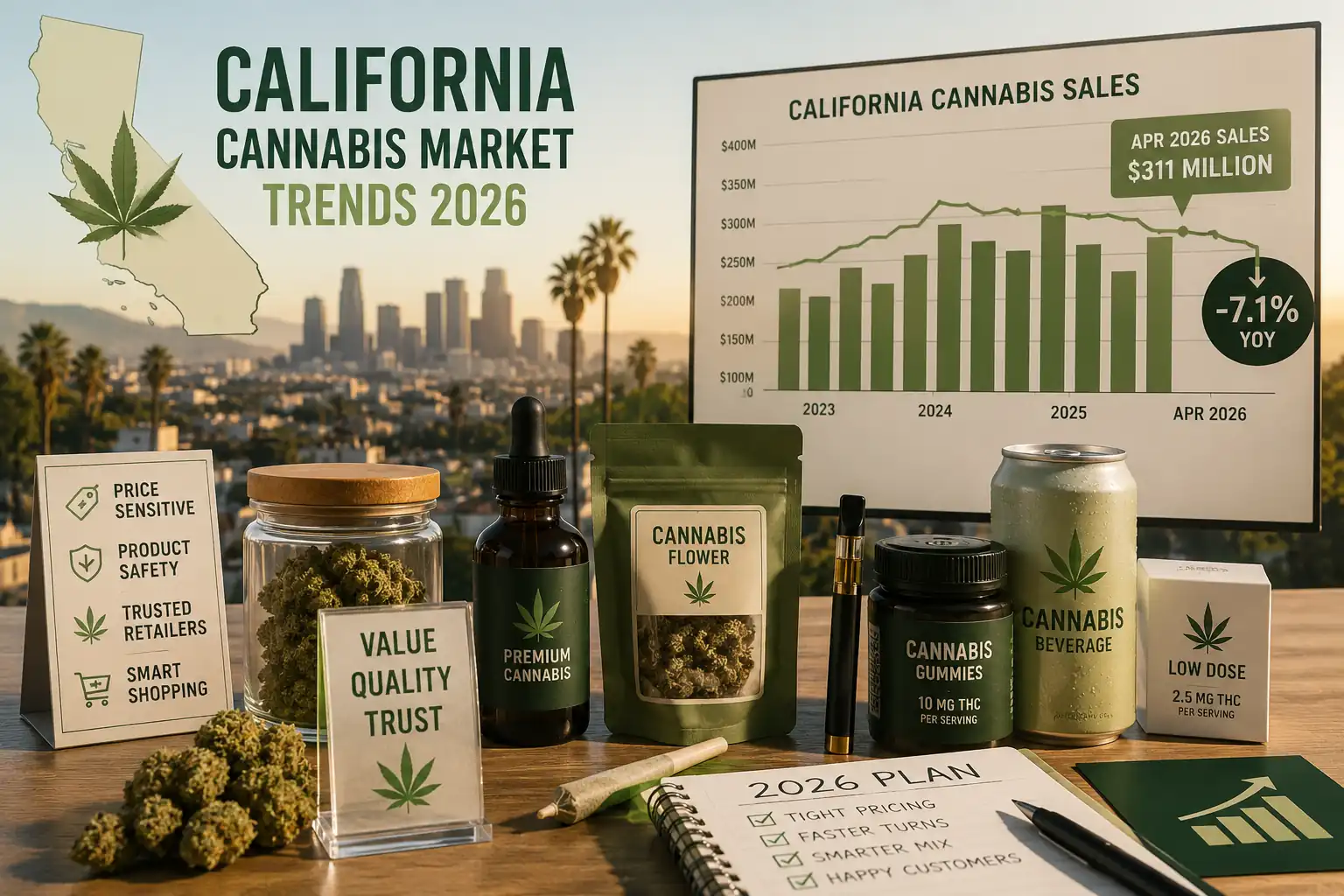
If you are watching California cannabis market trends in 2026, the short answer is this: the market is still huge, but it is tougher, more price-sensitive, and more product-diverse than it was a few years ago. California remains the biggest legal cannabis market in the United States. In April 2026, tracked sales reached about $311 million across more than 17.3 million units, but year-over-year sales were down 7.1%, and the average item price fell from $18.89 in April 2025 to $17.91 in April 2026.
What should you know first?
- Consumers are buying more carefully. Value, clear labeling, product safety, and trusted retailers matter more.
- Dispensaries need tighter pricing, faster inventory turns, and smarter product mixes, especially across flower, vapes, pre-rolls, edibles, and beverages.
- Taxes are less volatile than they looked in mid-2025 because AB 564 set California’s cannabis excise tax at 15% until 2028.
What are the biggest California cannabis market trends in 2026?
The biggest trend is maturity. California is not a new adult-use market anymore. It is a large, competitive market where growth is harder to win. That does not mean demand is gone. It means consumers have more choices, compare prices more often, and expect a better shopping experience.
Here is the quick picture:
| Market signal | What it means for consumers | What it means for dispensaries |
| April 2026 sales reached about $311 million | Legal cannabis is still widely available | Competition remains high |
| Sales were down 7.1% year over year | Deals and value products matter | Margin pressure is real |
| The average item price fell to $17.91 | Buyers may find better pricing | Retailers need sharp inventory control |
| Beverages grew while many core categories declined | More low-dose and social-use options | Beverage shelves deserve more attention |
Headset’s April 2026 market data shows both sides of the story. California still outsold other tracked states, including Michigan, New York, and Massachusetts, in April 2026. At the same time, California’s negative year-over-year growth shows that size alone does not guarantee easy wins.
For shoppers, these California cannabis market trends point to a better deal environment, but not always a simpler one. You may see more brands, more formats, more discounts, and more product claims. The best habit is to buy from licensed retailers, check the label, understand THC strength, and choose products based on your goal, not just the lowest price.
Why is price pressure such a big deal in California?
Price pressure is one of the clearest signals in the 2026 cannabis market. When the average item price drops, consumers may enjoy lower shelf prices. But for dispensaries and brands, lower prices can squeeze profits.
Several factors are working together:
- More competition among legal retailers and brands.
- Continued pressure from unlicensed sellers.
- Consumers are trading down to better-value items.
- Higher operating costs for compliant businesses.
- Category shifts that change what people buy and how often.
The Department of Cannabis Control says its public dashboards use licensing, harvest, sales, and track-and-trace data to show how the California cannabis industry is performing. That matters because retailers can no longer plan by gut feeling alone. They need data-backed decisions.
For a dispensary, price pressure does not always mean “sell everything cheaper.” It means you need a clear ladder:
- Good value products for price-sensitive shoppers
- Mid-range products with strong reviews and repeat demand
- Premium products for buyers who care about cultivar, terpene profile, small-batch production, or brand trust
- Staff picks that help shoppers make faster choices
For consumers, this is a good time to compare. Ask your budtender what is fresh, what is testing well, and what offers the best experience for your budget.
How are California cannabis market trends changing product demand?
Category demand is shifting, and it is not just about flowers anymore. Flower is still a major category, but shoppers are spreading their spending across vapor pens, pre-rolls, edibles, concentrates, and beverages.
In April 2026, Headset reported these California category sales:
| Category | April 2026 sales | Year-over-year change |
| Flower | $96.43 million | -10.6% |
| Vapor pens | $89.21 million | -5.5% |
| Pre-rolls | $57.39 million | -2.5% |
| Edibles | $38.06 million | -3.8% |
| Concentrates | $15.43 million | -9.6% |
| Beverages | $7.43 million | +8.0% |
Most large categories declined year over year, but beverages grew 8.0% in sales and 14.6% in units sold. Headset also noted that the average beverage price fell from $7.52 to $7.09, which likely helped more shoppers try them.
For quick planning, these California cannabis market trends show three practical shifts:
- Flowers remain important, but they cannot carry the whole menu.
- Vapor pens and pre-rolls remain key convenience categories.
- Beverages are small compared with flower and vapes, but they are one of the more interesting growth pockets.
Why are beverages getting more attention?
Beverages fit a different kind of cannabis moment. Many adults do not want to smoke. Some want a low-dose option. Others want a social product they can enjoy slowly.
That makes beverages useful for:
- Cannabis-curious adults who want a familiar format
- Consumers looking for low-dose THC
- Shoppers who want an alternative to alcohol
- Dispensaries that want basket-building add-ons
- Events and social settings were allowed by law
Still, beverages are not magic. They need education. Retailers should clearly explain onset time, dosage, serving size, and how the product differs from edibles.
What role will taxes and regulations play in 2026?
Taxes remain one of the biggest business issues in California cannabis. In 2025, the state moved through a major tax debate. AB 564 reversed a 25% tax increase and set the cannabis excise tax rate at 15% until 2028, according to the Governor’s Office. The same announcement said the goal was to help the legal industry stay competitive and support safe consumer access.
The Legislative Analyst’s Office estimated cannabis tax revenues of $648 million for 2025-26 and projected $661 million for 2026-27. Those numbers show that cannabis remains a major public revenue source, even while legal operators face margin pressure.
For dispensaries, the tax picture means:
- Price transparency matters. Customers want to know the out-the-door cost.
- Promotions should account for tax effects, not just shelf price.
- Retail teams need to explain why licensed products may cost more than unlicensed products.
- Operators should watch local tax rules, since city and county policies can vary.
For consumers, the main takeaway is simple. Licensed cannabis may not always be the cheapest option, but it offers regulated testing, labeling, and accountability.
Why does the licensed market still matter for shoppers?
The licensed market matters because cannabis is a product people put into their bodies. California’s Department of Cannabis Control says the state regulates the industry so businesses operate safely, products are contaminant-free and labeled, and cannabis is kept away from children.
That is not just a government talking point. It affects your everyday shopping choices.
When you buy licensed cannabis, you can expect:
- Required product testing
- Labels that show cannabinoid content
- Packaging rules
- Age checks
- Recall and safety systems
- A business that can be held accountable
California law allows adult-use cannabis purchases for people 21 or older, and medicinal purchases for people 18 or older with a physician’s recommendation. The state also notes that cities and counties may have stricter local cannabis rules.
So even in a mature market, the safest move is still to shop legally and locally.
What do 2026 cannabis trends mean for dispensaries?
For dispensaries, 2026 is not a year to rely on foot traffic alone. Shoppers are informed. They compare menus online. They look for deals. They ask about potency, price, freshness, effects, and brand reputation.
Here is what dispensaries should focus on:
1. Build a smarter menu
A strong menu should not be crowded for the sake of looking big. It should make shopping easier.
Use a balanced mix of:
- Best-selling flower eighths
- Convenient pre-roll singles and multi-packs
- Trusted vape brands
- Low-dose edibles
- Fast-moving beverages
- Concentrates for experienced users
- CBD or balanced THC: CBD products where demand exists
2. Train staff to guide, not pressure
Budtenders are still one of the biggest trust builders in cannabis retail. A customer may come in asking for the strongest product, but that may not be what they really need.
Good questions include:
- “What kind of experience are you looking for?”
- “Do you prefer smoking, vaping, eating, or drinking cannabis?”
- “Do you want something light, balanced, or stronger?”
- “Are you shopping for daytime or nighttime use?”
- “Do you have a usual dose?”
3. Make the value easy to understand
Many shoppers want deals, but too many discounts can train customers to wait. Instead, build value into the menu.
Try:
- Weekly staff picks
- Bundle offers
- Clear price tiers
- Loyalty rewards
- First-time customer education
- “Best for beginners” sections
- “Low-dose favorites” sections
These California cannabis market trends favor dispensaries that reduce friction. If customers can understand the menu faster, they are more likely to buy with confidence and return.
What should cannabis consumers watch before buying?
Consumers should look beyond THC percentage. THC matters, but it is not the whole experience. Freshness, terpene profile, product type, dose, and your own tolerance all matter too.
Before buying, ask yourself:
- Do I want fast effects or longer-lasting effects?
- Am I comfortable with inhaled products?
- Do I understand the dose per serving?
- Is this product from a licensed retailer?
- Have I checked local rules about where I can consume it?
The DCC reminds consumers to keep safety in mind and purchase only from licensed cannabis retailers. That advice is especially useful in a market where legal and illegal products can look similar online.
Which product categories look strongest for 2026?
The strongest categories are not all growing at the same rate. Based on current data, here is a simple read:
| Category | 2026 outlook | Why it matters |
| Flower | Still essential, but pressured | Big sales base, strong competition |
| Vapes | Strong convenience play | Portable, familiar, repeat-friendly |
| Pre-rolls | Good entry and add-on item | Easy for new and occasional buyers |
| Edibles | Stable, education-heavy | Dose control matters |
| Beverages | Smaller but growing | Good for low-dose and social-use shoppers |
| Concentrates | More niche | Often appeals to experienced consumers |
Dispensaries should avoid overreacting to one month of data. But they should review sales by category, margin, and repeat purchase rate every month. Consumers should use the same logic in a personal way. Notice what works for your body, budget, and routine.
How can dispensaries compete with unlicensed sellers?
Unlicensed sellers remain a serious problem for California’s legal cannabis market. The Governor’s Office said the Unified Cannabis Enforcement Taskforce has seized and destroyed more than 317 tons, or over 635,303 pounds, of illegal cannabis worth an estimated $890 million through nearly 230 multiagency operations since it was established in 2022.
Legal retailers cannot beat illicit sellers only on price. They need to win on trust.
That means:
- Show license information clearly
- Explain testing and labeling
- Offer fair pricing
- Keep online menus accurate
- Make pickup and delivery smooth where available
- Build loyalty through service, not just discounts
- Use education to show why legal products are safer
Consumers also play a role. Every purchase from a licensed retailer supports tested products, legal jobs, tax-funded programs, and safer access.
FAQ: California cannabis trends in 2026
1. What cannabis market trends should Californians watch in 2026?
They show a large but mature market. Sales remain high, but year-over-year growth is under pressure. Consumers are more price-conscious, and dispensaries need better menus, better education, and tighter operations.
2. Are cannabis prices going down in California in 2026?
Average item prices are lower than a year earlier in tracked data. Headset reported that California’s average item price was $17.91 in April 2026, down from $18.89 in April 2025.
3. What cannabis products are popular in California right now?
Flower, vapor pens, pre-rolls, and edibles remain major categories. Beverages are much smaller, but they showed positive year-over-year growth in April 2026.
4. What should California dispensaries do in 2026?
Dispensaries should focus on pricing clarity, accurate online menus, staff education, loyalty programs, product freshness, and balanced inventory. They should also watch beverages and pre-rolls closely.
5. Should consumers buy from licensed cannabis dispensaries in California?
Yes. Licensed dispensaries sell regulated products with testing, labeling, packaging, age checks, and accountability. This helps consumers avoid unsafe or unknown products.
Final takeaway
The California market is not slowing because people stopped caring about cannabis. It is changing because shoppers are more selective, prices are tighter, and product choices are broader. As California cannabis market trends continue to shift in 2026, consumers should shop with safety and value in mind, while dispensaries should focus on trust, education, and smart inventory. For shoppers who want a reliable legal retail experience, KOLAS supports informed cannabis choices with a focus on quality, service, and responsible access.